
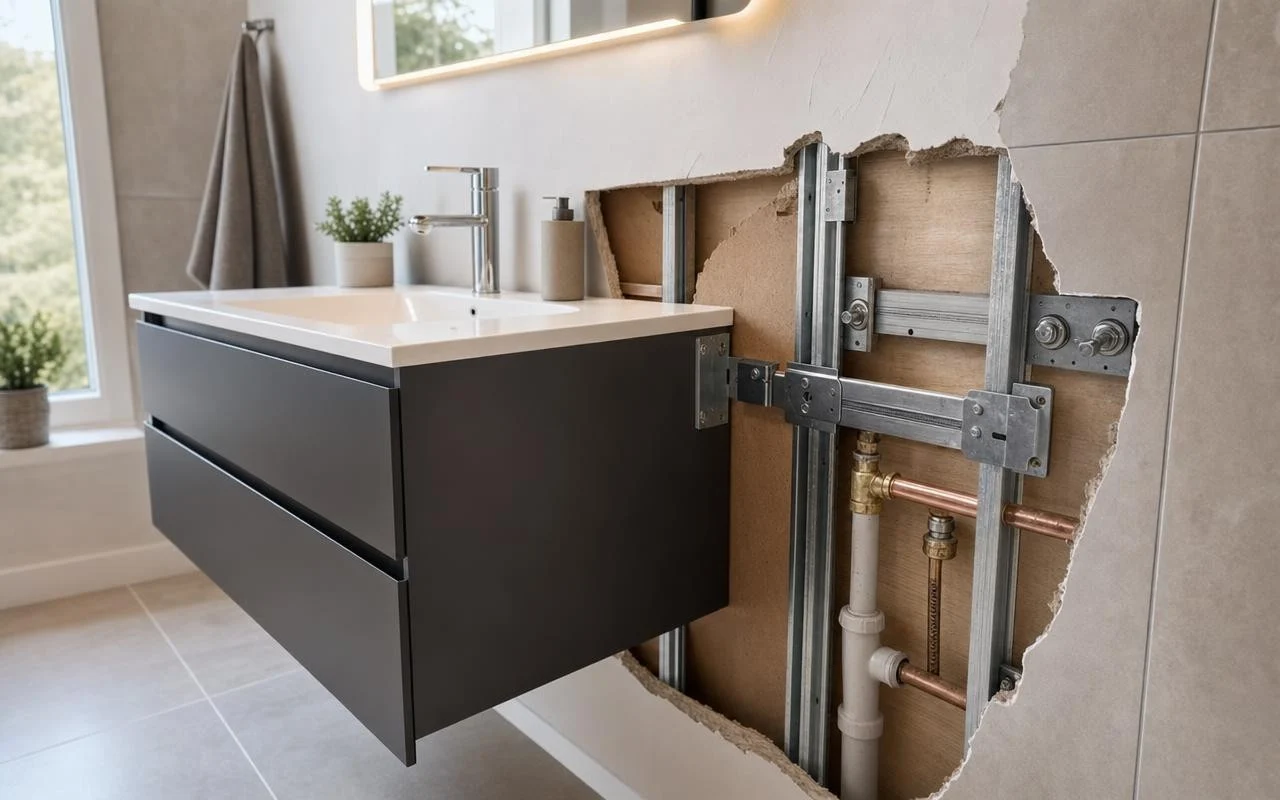
It all began with a very simple wish: to remove the old bulky cabinet and replace it with a wall-mounted model, visually lighter, so that the tilework could run uninterrupted from one wall to another. In the evening, the bathroom seemed bigger, more modern, almost worthy of a catalog. Then one morning, a sharp crack, the sink barely moves, that hollow feeling in the stomach that says the wall has just endured a strain.
In many renovations, this scene doesn’t end there. The suspended vanity, now a standard, actually concentrates all its weight on a plasterboard partition sometimes installed without reinforcement. When it finally gives way, the vanity becomes one with the plasterboard, the insulation, the tiles, and sometimes the embedded water supplies. Everything hinges on how the partition was conceived from the outset.
Suspended vanity: when the plasterboard truly fails
A vanity unit doesn’t weigh only its cabinet. You must account for the ceramic basin, the water, the drawers filled, and the person leaning on the edge. This mass acts at about thirty centimeters from the wall, in a cantilever, like a lever arm that constantly pulls on the screws. The plasterboard bears vertical pressure reasonably well, far less this traction that tries to extract the fastenings from the partition.
Even a metal expansion plug remains only in a few millimeters of material. Over time, the threads grind the plaster and the hole becomes oval. Manufacturer documents for plasterboard remind that beyond roughly thirty kilos of concentrated load, continuous reinforcement becomes essential, some reinforced systems advertising up to sixty kilos per point when everything has been planned from the outset. This role is fulfilled by a metal rail, a wooden batten, or a very dense panel screwed to the frame before tiling, or even by a self-supporting backing that transfers the weight directly to the floor.
The telltale signs on the plasterboard partition
Testimonies agree: “A partition that gives way never does so without warning.” Subtle clues appear well before the collapse, if you know how to look for them.
- A slight wobble of the furniture as soon as you lean on the basin.
- Microcracks above the screws, aligned with the fixing points.
- Silicone that peels away from the wall along the full height on one side.
- The screw head begins to protrude from the board.
Facing one of these signals, you must react without delay: empty the cabinet, stop leaning on the sink, if possible place a temporary leg, then request a check of the fastenings and the interior of the partition. The day everything gives way, the plasterboard often tears away along with the insulation and the hot and cold water pipes placed just behind. The connectors can shift, crack, and the water then begins to seep behind the tiles. For hours, nothing is visible, until the puddle on the floor appears. “A water damage that starts on a Sunday morning never warns anyone.”
Reinforcing the partition and securing the vanity
In renovation, not all is lost. A professional can sometimes move the vanity a few centimeters to align with an existing reinforcement, or add discreet adjustable feet. A bracket anchored to a neighboring load-bearing wall also helps limit the load on the partition.
On a new project, the key point remains the reinforcement planned before tiling. The estimate should mention its type, its height, and its width relative to the suspended vanity. Then, a stability test, repeated every six months, reassures the durability of the wall.
