
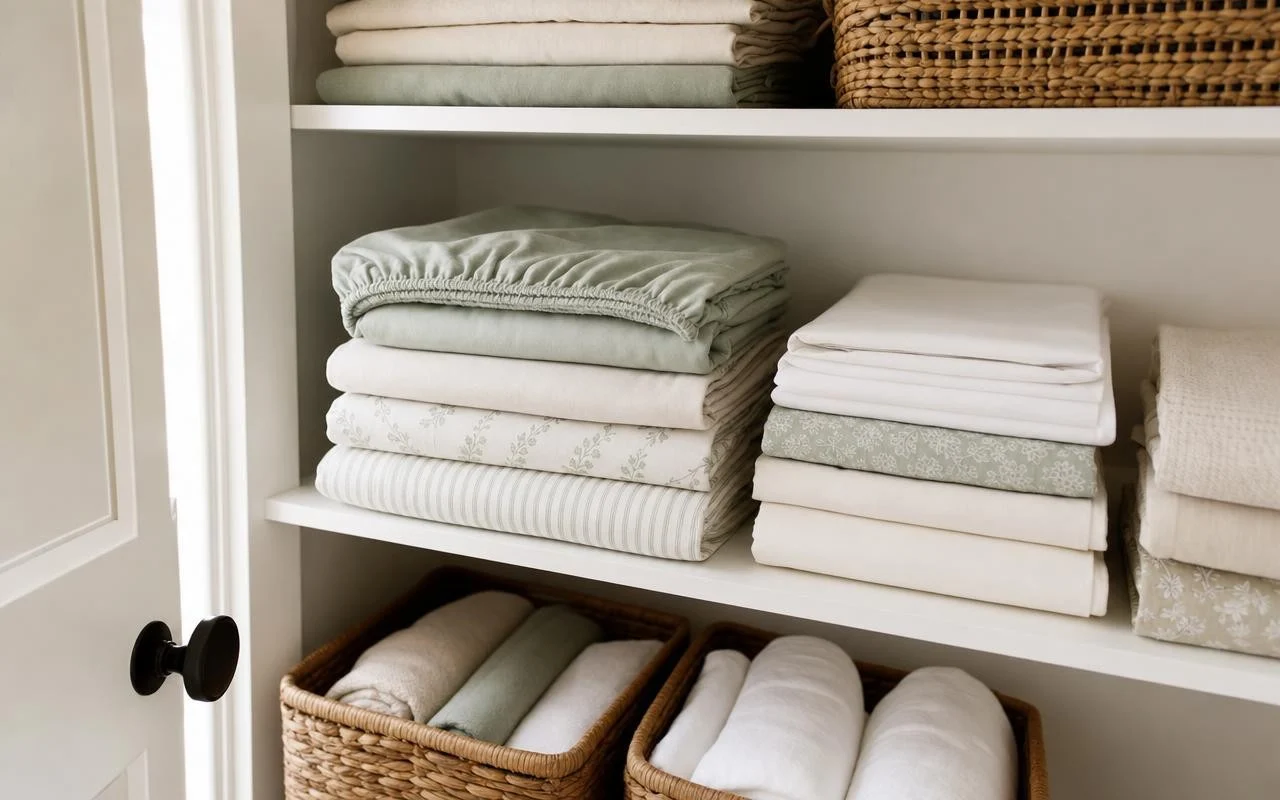
The fitted sheet is the undefeated champion of laundry piles that collapse. Between the elastic corners that puff up, the fabric that rolls on itself, and the closet already full, we often end up stuffing it into a ball. Result: a bed that isn’t as neat, wrinkled sheets, and a storage space that always seems too small.
Yet experts like Jolanda Thomas, bedding specialist, and Tyler Moore, organizing pro, show that with a few precise moves and a coherent storage plan, this stubborn sheet can be tamed. The key lies in how you handle the elastic corners… and in how you fill your shelves.
Pourquoi le drap-housse ne tient jamais plié dans le placard
A fitted sheet doesn’t behave like a flat sheet. The deep corners and the elastic create volume, especially for thick mattresses. If you fold it carelessly, each corner forms an air pocket that makes the stack bulge. At the slightest movement, everything comes apart and the laundry pile turns into an amorphous block.
Another issue: storage. A poorly wrung or slightly damp sheet ends up wrinkling, or even smelling musty. Bedding specialists remind us that it must be completely dry before putting away. Jolanda Thomas adds that “overfilled linen closets prevent air from circulating, which can give sheets a musty odor.” A stuffed closet also brings out more creases.
The simple method to fold a fitted sheet into a stable rectangle
For Jolanda Thomas, it all starts with the shape. She sums it up: “The best way to fold a fitted sheet is to tuck all the elastic corners into one another, give it a rectangular shape, then fold it in three,” explains Jolanda Thomas. Place the sheet inside-out on a bed or a large table, slide your hands into two adjacent corners, then nest them together.
Do the same with the other two corners, then stack these two “elastic pockets.” You end up with a large U that you guide into a rectangle by smoothing the elastic inward. Fold the free edges toward the center to form a neat rectangle. Adapt the width to your closet: a three-fold for a deep space, a four-fold if the shelf is narrow, as Jolanda Thomas advises when she suggests adjusting the fold to the available space.
The right storage habits to keep the fitted sheet neatly stored
Once the drap-housse is in a compact rectangle, storage makes all the difference. Always keep it perfectly dry and well cooled. To maintain neat, easy-to-grab stacks, many organizers recommend tucking the folded fitted sheet, the flat sheet, and a pillowcase into the matching pillowcase: you get a complete “pack,” ready to grab. Jolanda Thomas also advises: “To prevent a batch of sheets from sitting unused for too long, place freshly washed sheets at the bottom of the stack or bin and always take from the top when you change the sheets,” says Jolanda Thomas.
Tyler Moore, who organizes very compact laundry rooms, reminds us that “the best storage systems are those that can evolve and be reconfigured easily as needs change.” His rule “one container = one category” works very well for bedding: one bin for 140 cm sheets, one for 160 cm, one for guest bed. To keep your folding impeccable over time, a few pointers help:
- Never crush the piles: leave a bit of space for air to circulate.
- Adapt the folding (three- or four-fold) to the depth of the shelf.
- Store each complete set in a pillowcase to prevent mixing.
- Use bins or boxes by bed size, rather than a single large stack.
If you have limited space in the linen closet, Jolanda Thomas suggests using bedroom furniture: the bottom drawer of a dresser, a chest at the foot of the bed, or decorative boxes on a shelf. Duvets and bulky blankets can slide under the bed, protected in cotton bags that allow air to circulate. Your well-folded fitted sheet will stay compact, easy to find, and ready for the next bed change.
Sources
- Maison & Travaux
“This tiny laundry room hides 5 amazing storage tricks to copy before you really run out of space”
