
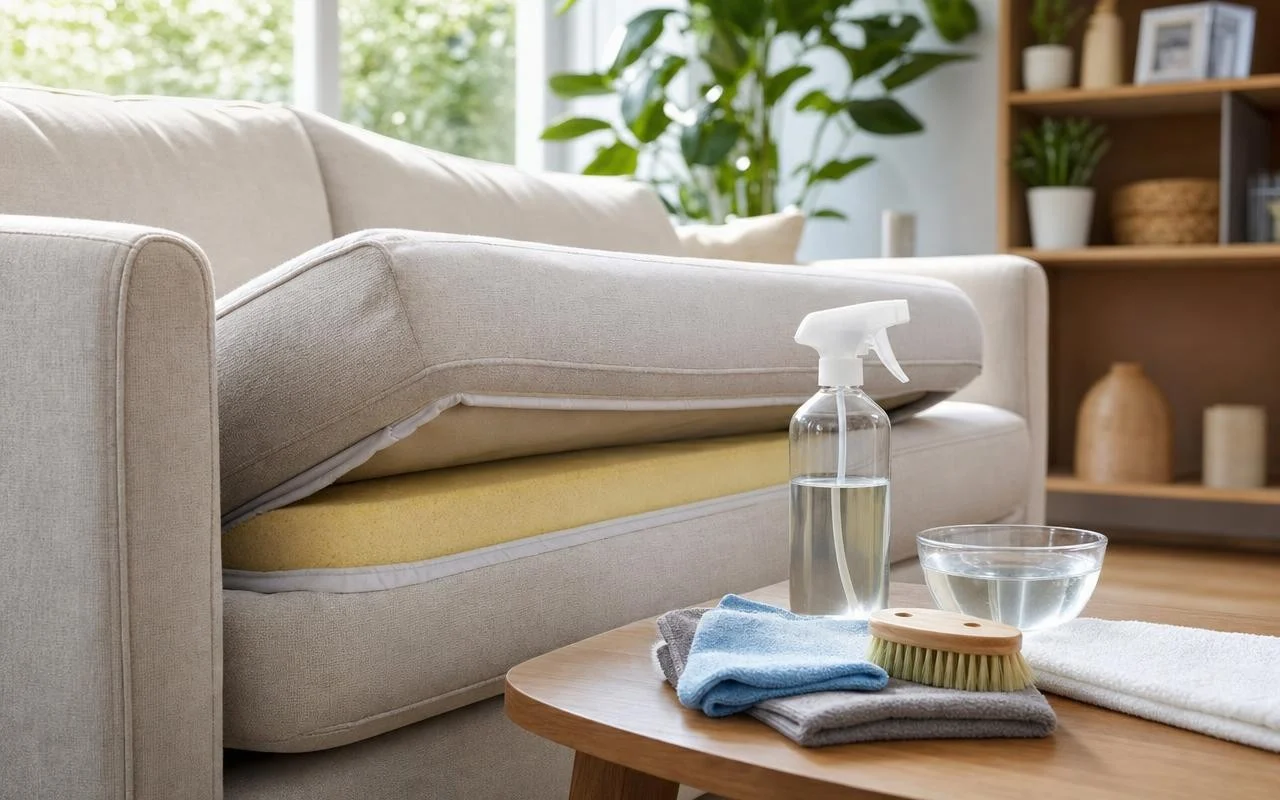
On my fabric sofa, I thought I was doing the right thing by pulling out the shampooer and the bucket of soapy water. At each stain I scrubbed, I rinsed, until the fabric was completely soaked. In the moment, everything seemed cleaner. Then, as it dried, halos appeared, the smell became somewhat suspect, and the seat began to deform slowly.
Digging deeper, I discovered that this everyday piece of furniture is a real nest for dust, dead skin, crumbs and bacteria—much more than a sheet you run through the machine. And above all that, one invisible element decided everything: the filling foam. It was there that I understood this simple rule with water, the one that made me stop shampooing.
Fabric sofa: why I stopped shampooing it with large amounts of water
Under the fabric lies a thick, highly absorbent foam. As soon as you flood the seat, it behaves like a sponge: it drinks the water in a few minutes, but sometimes takes more than 24 hours to truly dry. In that damp, confined environment, mold and stale odor set in, and stains reappear as halos when moisture climbs back to the surface. The rule that has become my reflex is crystal clear: water must never reach the foam.
Claire’s mishap, recounted on My Jugaad, illustrates this trap well. After a wine stain, she says: “I thought I was doing well, but the stain spread, and as it dried you could see worse: a big light halo. I wanted to give up entirely.” Her grandmother immediately reminds her: “You never drown a sofa, especially not yours.” As long as you treat only the fabric surface, with very little moisture, you avoid exactly those halos that ruin everything.
Codes W, S, WS, X: the basic rule before cleaning a sofa
Even before thinking about products or DIY recipes, it all starts with the small label stitched under the seat. Manufacturers indicate a code: W for water-based cleaning, S for dry cleaning only with a solvent, WS for both options, X for dusting with no liquid at all. If your sofa shows S or X, water is to be avoided and only dry cleaning or professional intervention is feasible for real stain removal.
- Vacuum the fabric and folds thoroughly.
- Read the code W, S, WS or X and follow it.
- Always test on a hidden area.
- Work in small zones to keep control.
- Limit the amount of water used as much as possible.
For a sofa with code W or WS, it is still possible to clean without soaking, provided you ban the bucket of lukewarm water in which you rinse the sponge. Even with a shampooer in injection-extraction mode, specialists remind that you must inject very little liquid and extract immediately. In a well-ventilated room or with a fan, they mention a touch-dry time of 4 to 8 hours, compared with more than 24 hours in a closed living room.
Foam method and halo-preventing gestures to clean a fabric sofa
The method that replaced my old shampoos comes from a simple trick: make foam, not soapy water. Dissolve a detergent pod in a bowl of hot water and whisk until you obtain a dense foam. With a well-wrung microfiber glove, apply only this foam to the fabric, in small circular motions, without soaking. Source: Journal des Seniors; the secret is to keep the textile just damp on the surface, never wet throughout.
Next comes the sequence of halo-preventing gestures. Remove the excess with a clean, slightly damp cloth, then wipe with a dry cloth to speed up drying. For a fresh wine stain, Claire’s grandmother suggests a precise mixture: 500 ml warm water, 2 tablespoons white vinegar, 1 tablespoon dishwashing liquid. “Dab it without rubbing!” she insists, before adding: “My dear, the secret is to work slowly, test on a hidden corner first, and dry immediately.” Ventilating the room afterward blocks surface moisture and keeps the foam safely tucked away.
