
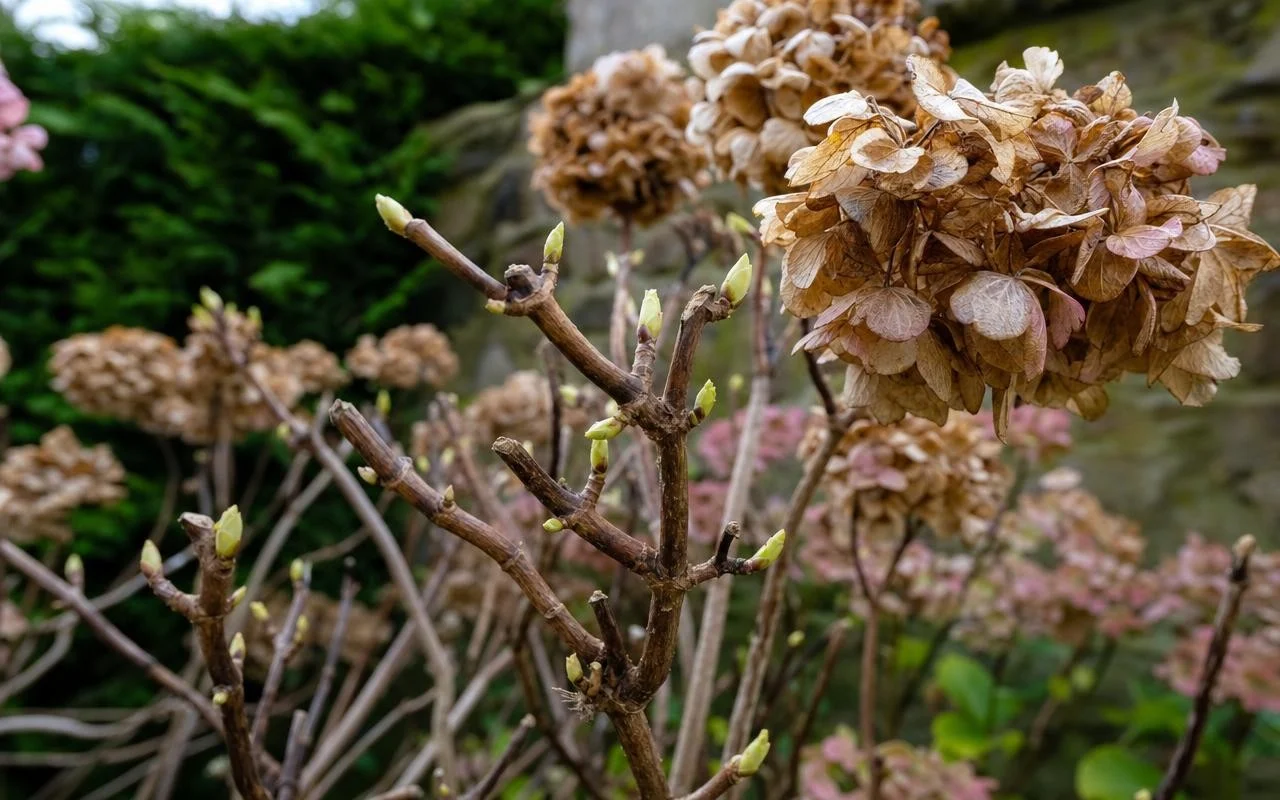
In September, faced with the large round clumps of flowering hydrangeas turning brown, many gardeners grab the pruning shears to “make it tidy.” The stems are shortened to a uniform level, the dry heads disappear, and the bed looks neat for winter. Then, the following summer, surprise: the shrub stays very green, vigorous even, but almost without blossoms.
The old-timers knew this scenario well and kept their distance. They hardly ever pruned their hydrangeas in September, especially Hydrangea macrophylla with their big, rounded heads. They left the dried flowers to stay all winter, then intervened at the very last moment. Everything was already decided in the stems, well before winter.
Why pruning hydrangeas in September makes the bloom disappear
With the hydrangea Hydrangea macrophylla, the most common one in gardens, floral buds form at the end of summer on the wood from the previous year. They hide just beneath the faded inflorescences, at the tips of the flowering stems. In October, a stem that seems dormant already carries, in these tiny buds, the clusters that will bloom next July. By cutting off the tip in September, one simply severs these future flowers.
This mismatch between pruning time and blooming explains the famous “bare bed” that worried the old gardeners. The hurried gardener cuts back all the stems of his hydrangea to the same height in autumn; in spring, the plant grows back vigorously, produces a lot of foliage, but almost no buds. It isn’t a matter of missing fertilizer or watering: only cuts that are too low, made at the wrong moment, have removed the next year’s buds.
The detail the old ones looked at before pruning their hydrangeas
Before bringing the pruner near, the old ones would roll the spent stem between their fingers until they felt a first pair of clearly swollen bumps. These two buds, facing one another, already contain everything that will form the new stem and the future inflorescence. The rule was simple: cut the stem about one centimeter above this first pair of well-formed buds, never lower, to leave intact all the flowering potential.
On Hydrangea macrophylla, bygone gardeners were content to leave the brown heads all winter. These dried flowers formed a hood above the buds, protecting them from cold rain, wind, and frost. Opening a pruning wound in September exposes the stem to moisture and fungi for months. At the end of winter, they would remove the dead flowers by following their bud landmarks, with a clean, sharp secateurs.
The right calendar for pruning hydrangeas without losing summer
For the Hydrangea macrophylla, the real pruning comes at the end of winter, when there is no risk of frost, usually between February and March depending on the climate. A landscape gardener quoted by the magazine Mon Jardin et Ma Maison summarizes: “the best time for a strong pruning remains the end of winter, around February.” One follows the stem from the dry flower to the first visible large buds, then cuts just above. Renewal is achieved by removing each year only a portion of the oldest stems.
In September, on a macrophylla, one limits oneself to the minimum: remove dead wood, cut flush the broken stems, air out the center a bit, water a potted plant or take a basal-layer cut, without touching the ends. The hydrangeas Hydrangea paniculata and Hydrangea arborescens, recognizable by their large panicles or white globes, bloom on the wood of the current year and tolerate a short pruning at the end of winter. In case of doubt, simply wait for spring.
