
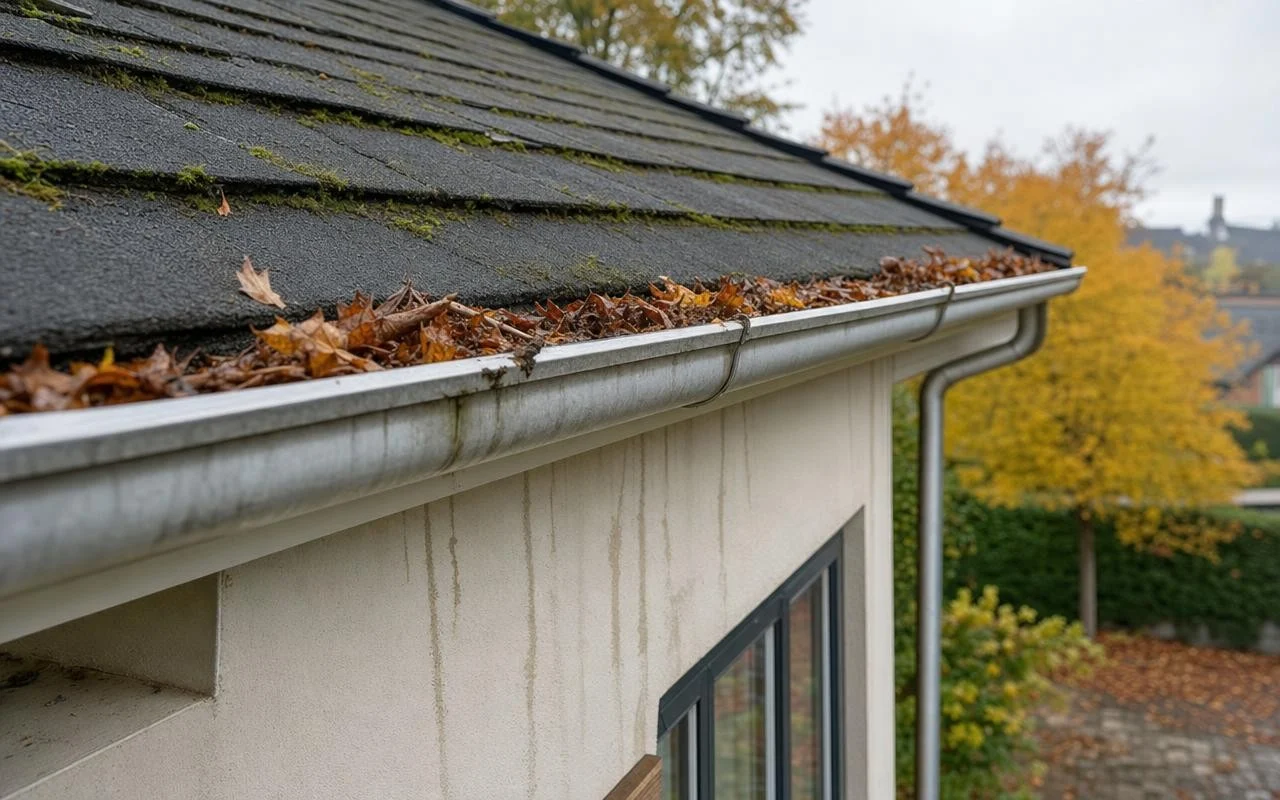
When you step out of your house this month, lifting your eyes to the roof can change everything. In barely three seconds, this glance can spot sometimes a gutter that overflows, a dark stain on the render, a component that didn’t stick yesterday. Behind these subtle details lies the protection of your home against the first autumn rains, the ones that reveal weaknesses in the rainwater drainage system.
If roofers sound the alarm in September, it isn’t for the pleasure of dramatizing. They witness year after year the same scenes: gutters saturated with leaves, a clogged leaf guard, water pounding the facade before seeping into the masonry. It all begins, however, with this simple reflex, free and invisible to the neighborhood, of looking at your roof at the right moment. This calendar works against you as autumn settles in.
Look up at your gutters: the 3-second test
A roof never warns by speaking; it merely offers small signals that a hurried eye ignores. A faint greenish trace climbing up the render, a trickle of water tracing a strange path after a downpour, a gutter that looks sagging under the weight of debris: these are often the first signs of a gutter starting to become clogged. Observed from the garden or the sidewalk, these cues are recognizable at a glance.
Roofers advise taking this quick look during or just after rain, when the water betrays the blocked circuit. If you see water flowing over the metal, streaming in sheets along the wall, or forming vertical threads beneath the downspout entry, the message is clear: the drainage chain, from the gutter to the rainwater downpipe, is no longer performing correctly.
Why cleaning your gutters in September prevents catastrophe
All summer, a slow trap builds up above the house. The trees shed seeds, spent flowers, and small branches; the wind brings dust; moss takes advantage of the humidity and warmth to colonize corners. By the end of the season, the gutters often harbor a compact mix of organic matter that partially blocks the flow, without anything being visible from the ground.
That is where the choice of month makes all the difference. In September, it is time to clean your gutters before the heavy rains apply pressure to this invisible blockage. Waiting until November means letting each shower transform the obstructed gutter into a spillway against the facade: water runs along the wall, penetrates the masonry, ascends by capillarity, and ends up seeping inside as brown stains, musty odors, or blistering paint, sometimes months later.
Leaf guard and downspout: the real weak point to monitor
For professionals, the weakest link isn’t even the eavestrough, but this small grille at the entrance to the downspout: the leaf guard. As wide as a palm, it filters the leaves before they fall into the pipe, and it becomes blocked in a few days as soon as the wet leaves stick to it in a compact paste. The backed-up water then has no outlet, backs up locally, and hits the render just under the grille, creating those moisture traces that rise on the wall.
A blocked downspout sends water back toward the foundations and, in winter, frost can distort the gutter. Roofers speak of gutters that last twenty to thirty years when leaf guards and downspouts are checked in spring and autumn, spotted with binoculars, then entrusted to a professional if access seems risky.
