
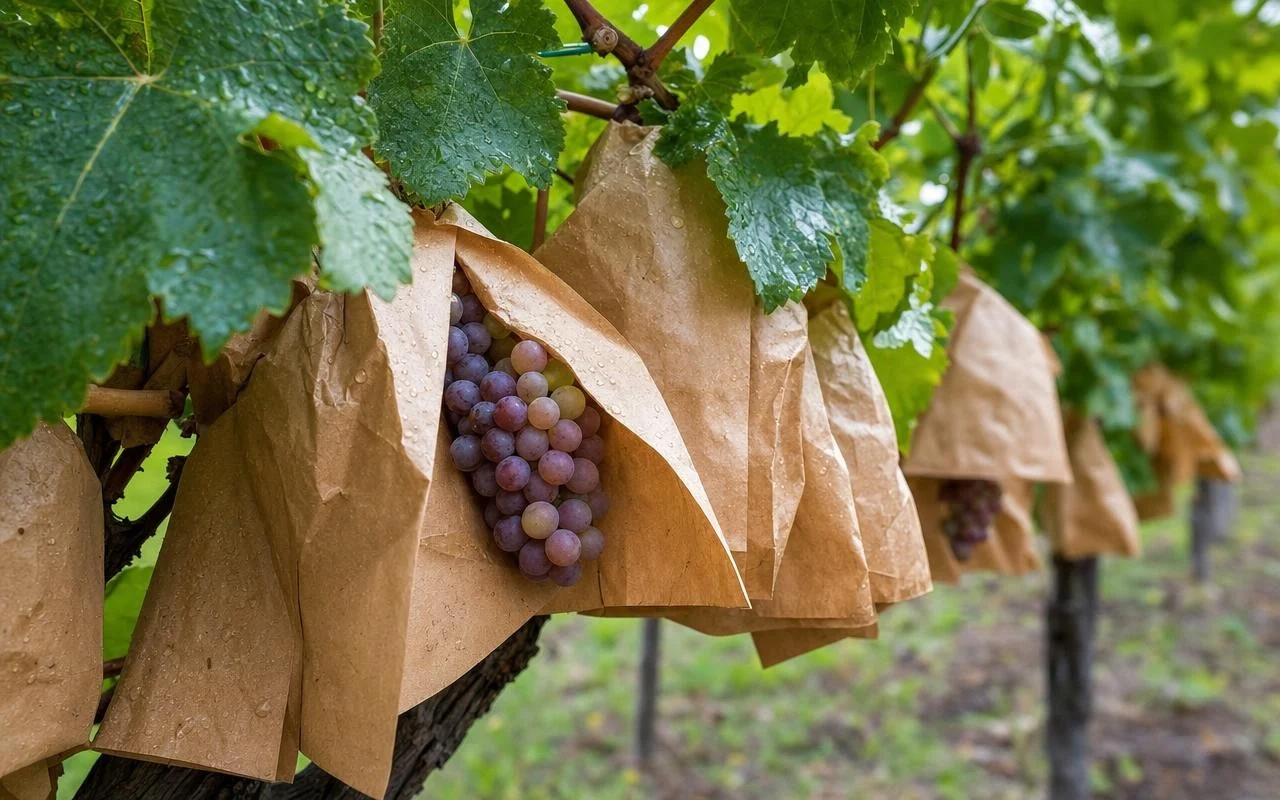
In some family gardens, you can still spot those small kraft paper bags swaying in the wind, hung on the vines like quirky lanterns. Neighbors wonder about them, children take them for decorations, and many imagine they provide a bit of shade for the clusters. This discreet gesture, however, stems from a very precise know-how handed down by the elders, season after season.
At the end of summer, when days stay warm and nights grow more humid again, table grapes enter their most delicate phase. It is at this moment that our grandparents would bring out their piles of paper bags and bag, without hesitation, every well-formed bunch. For them, there was no room for waiting: a few days too long could be enough to lose half the harvest. Everything hinges on a key step, the veraison.
Early September and veraison: the moment when the cluster becomes vulnerable
The elders watched the color of the berries rather than the calendar. When the berries began to yellow or blush, softened slightly and lost their sharp acidity, they knew that the veraison had begun. In many French regions, this shift occurs around early September. From then on, the grape becomes loaded with sugars and suddenly attracts everything that flies or crawls in the garden.
The heat amplifies this phenomenon. When water is scarce, the fruits concentrate sugars, and the vine releases powerful fragrances under the sun. Insects such as the Asian hornet, which also targets bees, then ease off on hunting to nip the ripe berries, much like ordinary wasps. Night humidity or stormy rains finish weakening the cluster by promoting diseases, including the dreaded gray mold.
Wasps, birds and diseases: three enemies for the same cluster
As soon as the juice turns sweet, the wasps begin circling around the vines. They pierce the skin of a berry, suck out its contents, and move on to the next. These tiny wounds turn each berry into an open doorway for fungi. In some gardens, the hornets, including the invasive species from Asia, join this feast and shred entire clusters in just a few days.
At the same time, blackbirds and starlings patrol the streets. A few passes are enough to empty a heavily laden vine, leaving only the scraps. When the skin of the berries has been damaged by the bites or beak taps, the gray mold quickly takes hold if the weather remains humid. It is this succession of attacks that the elders sought to curb by systematically practicing the bagging of table grapes clusters.
Bagging grape clusters properly and creating a protective microclimate
The equipment remains very simple: fairly wide kraft paper bags and a small tie. Plastic is avoided, as it traps condensation against the berries. To follow the old method, there are only three steps to take.
- Wait for the onset of veraison, when the berries change color.
- Slip the bag around the cluster without tightening or crushing it.
- Close around the peduncle with a flexible tie, allowing air to flow.
Once the clusters are sheltered, the bag creates a small microclimate. Heat builds up there a little during the day and dissipates more slowly at night, which smooths out ripening and increases sugar concentration. It is enough to monitor after heavy storms and remove the bags just before tasting.
