
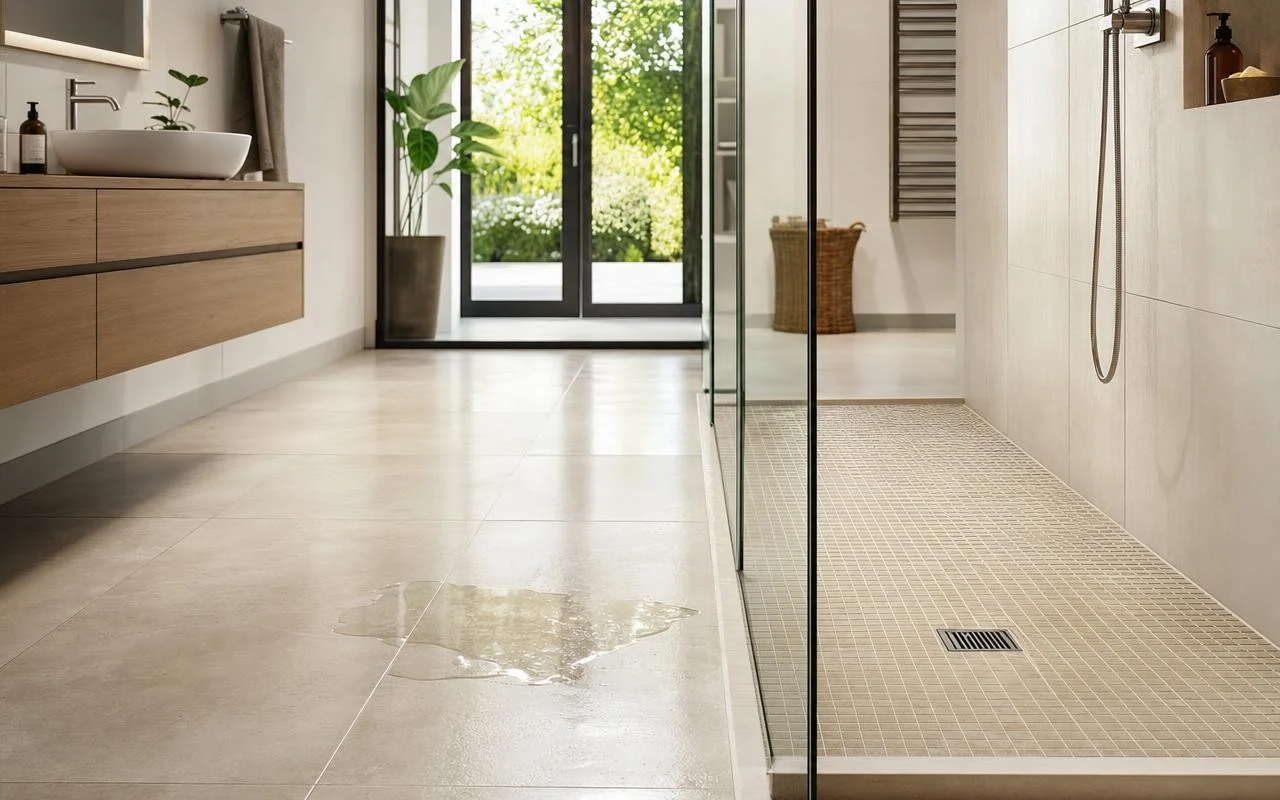
Large-format coatings are taking over catalogs: marble-effect slabs, oversized porcelain slabs, floors nearly seamless that catch the eye. In photos, everything looks perfect. But in real life, when renovating a bathroom, this trendy choice can turn into a source of headaches, especially around the shower and the drain.
The architect Damián Revelli, who regularly shares building and renovation tips on Instagram (@remodelatucasa.ok), has noticed it in the field. In a video that went viral in 2026, he warns against certain “very flashy and attractive” materials that, once installed in a bath, “become a big problem.” To avoid stagnant water, humidity and slipping, he sums up his experience in a simple rule that runs counter to fashion trends.
Pourquoi Damián Revelli mise sur de petites pièces au sol de la salle de bains
Facing the rise of large-format tiling, Revelli starts with a clarification: “In a bathroom, there should always be small pieces,” he says. Porcelanato, those large slabs that allow changing the floor with few joints for a uniform look, illustrates, in his view, this seemingly good choice that is actually misleading. Visually, the result is smooth and harmonious, but the permanent presence of water completely changes the criteria for selection.
In a bath, water plays a central role: it flows, splashes, and sometimes pools. For this reason, the architect recommends using small tiles, especially on the floor, to properly create the slopes that guide water toward the drainage grate. The problem is amplified in the shower, where water falls directly in the same spot and quickly begins to pool if the slope isn’t sufficient.
Large floor slabs: why the shower quickly becomes a headache
For Damián Revelli, the difficulty mainly stems from the rigidity of large slabs. Around the drain, the surface must form like a funnel to direct the water; with large-format pieces, you need to multiply cuts to follow this slope, which complicates the project and raises the bill. “In the end, we will spend more money and the result won’t be good,” warns the architect.
With small pieces, as he calls them, the surface adapts much more easily: the joints between tiles allow adjusting the level in small steps, without breaking or deforming the materials. According to him, two aspects must be taken into account: aesthetics and functionality. On the first point, porcelain slabs win out. But in daily use, they can lead to humidity problems, water that does not drain well, and mold, including in the layers beneath the coating.
Sol de salle de bains, sécurité et alternatives selon Damián Revelli
In his message, the architect clearly distinguishes the floor from the walls. On vertical surfaces, he favors large decorative slabs, which offer a neat finish with fewer visible joints. On the floor, however, both in the shower and in the rest of the bathroom, he strongly discourages them: “This is the part of the house where there are the most slip-related accidents,” he notes. He also invites looking at another criterion besides tile size: their slip resistance.
“Glossy floors are very dangerous,” insists Damián Revelli, because once wet they easily cause slips and falls. For him, safety must come before the sole pursuit of a spectacular effect. He also cites microcement as a possible solution during a renovation, thanks to its seamless appearance and the possibility of giving the exact slope toward drainage. This material, however, requires a very careful implementation, with an effective waterproofing and sealing system to prevent the appearance of cracks.
