
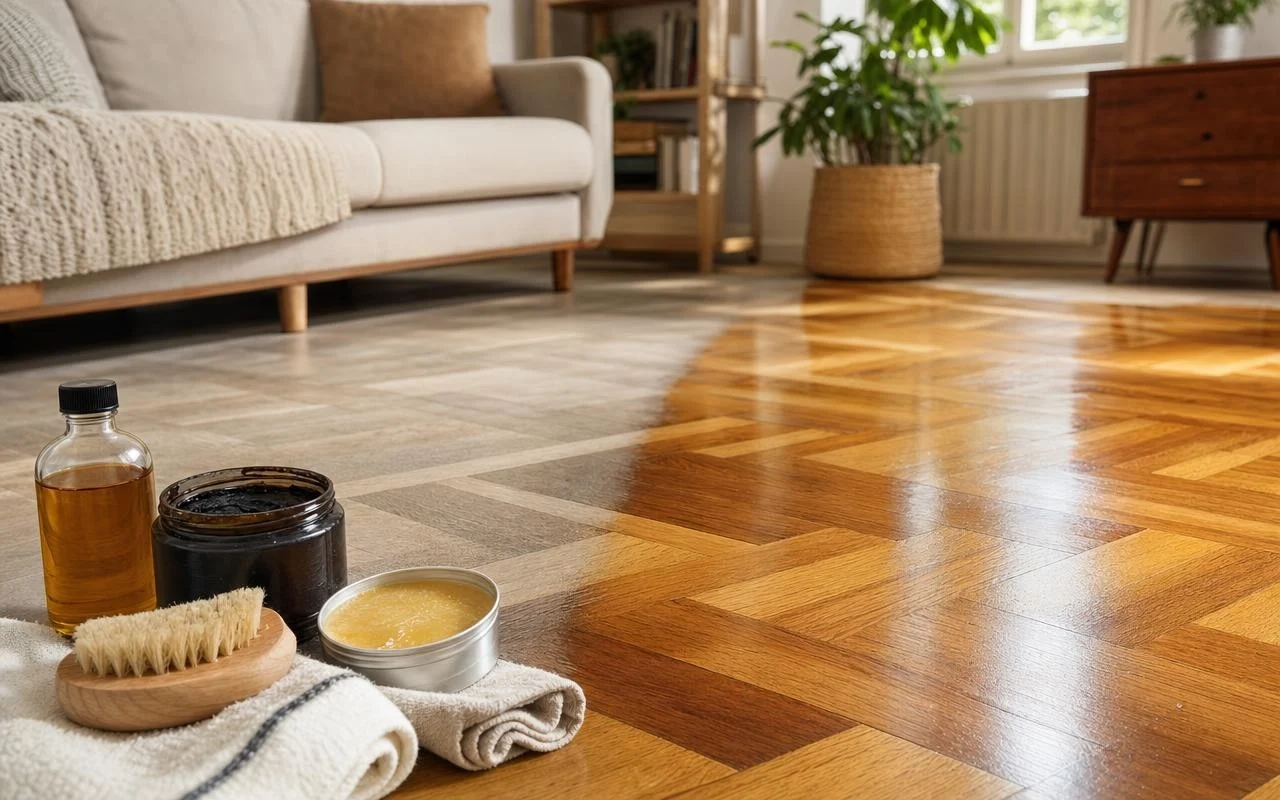
Your wooden floor has dulled, and you neither feel like renting a heavy polisher nor starting a renovation project. Renting a single-disc polisher, moving furniture, and the noise often discourage people from taking the plunge. Yet, a thoughtfully executed manual buffing is enough to smooth out small scratches and restore the wood’s shine.
According to the Interior Air Quality Observatory in 2025, about 68% of French households already prefer ecological maintenance solutions for their floors. With a few cloths, a microfiber mop, and simple products such as black soap, linseed oil, or beeswax, you can buff a parquet without a polisher. Provided you know the right method for each finish.
Identify the finish of your parquet before hand buffing
First instinct: check whether the wood is protected. Place a drop of water on a discreet area; if it beads, the floor is sealed with a varnish or a vitrifier, typical of a vitrified parquet made with polyurethane. If the water spreads then slowly penetrates, you’ve probably got an oiled or waxed parquet. When it disappears almost instantly, the wood is raw or only stained, too fragile for a heavy polish.
To differentiate a waxed parquet from a polyurethane-vitrified floor, gently rub a very fine steel wool on a hidden corner. If a gray, somewhat paste-like substance deposits on the wool, the surface is waxed; with no residue, it’s varnish or polyurethane. Specialists’ recommendations are clear: no wax on polyurethane varnish, or you risk a sticky film that is difficult to remove.
Prepare the parquet: gentle cleaning without professional equipment
Once the finish is identified, the success of the buffing mainly depends on preparation. Floor-care experts recommend a long-pile microfiber broom rather than a conventional vacuum, following the grain of the boards to trap dust and sand grains. This step helps limit micro-scratches responsible for the dull appearance. For washing, use a microfiber mop cloth that is very well wrung and lukewarm water, never hot.
For a thorough cleaning without harsh products, black soap is a staple. The most commonly used protocols call for 2 tablespoons of liquid black soap for 5 liters of warm water, applied with the mop cloth nearly dry. White vinegar helps degrease, provided you dilute it to 100 milliliters per liter of water and limit its use on oiled or waxed parquet. The floor must dry completely before any buffing.
Natural methods to buff a wooden parquet without a polisher
Next comes the choice of finishing product, to be adapted to the type of parquet. On a waxed parquet, the traditional recipe mixes 100 grams of grated beeswax with 50 milliliters of turpentine, melted in a double boiler and then left to cool. This paste is applied in a very thin layer with a wool cloth, left to dry for about twenty minutes, then buffed vigorously with a clean cloth or a gentle buffing pad. Trials reported show a shine that remains stable for two to three months.
On an oiled or raw parquet, pure linseed oil applied with a cloth along the grain, left to sit for about 30 minutes then carefully wiped, nourishes the wood and restores depth. For a quick sparkle on a vitrified or oiled parquet, a simple mixture combines three parts olive oil with one part lemon juice, always tested first on a hidden area. Regardless of the product chosen, the ideal is to work by hand in small zones of about 90 centimeters by 90, in circular motions, then let dry for at least one hour before walking on it and twenty-four hours before moving furniture.
