
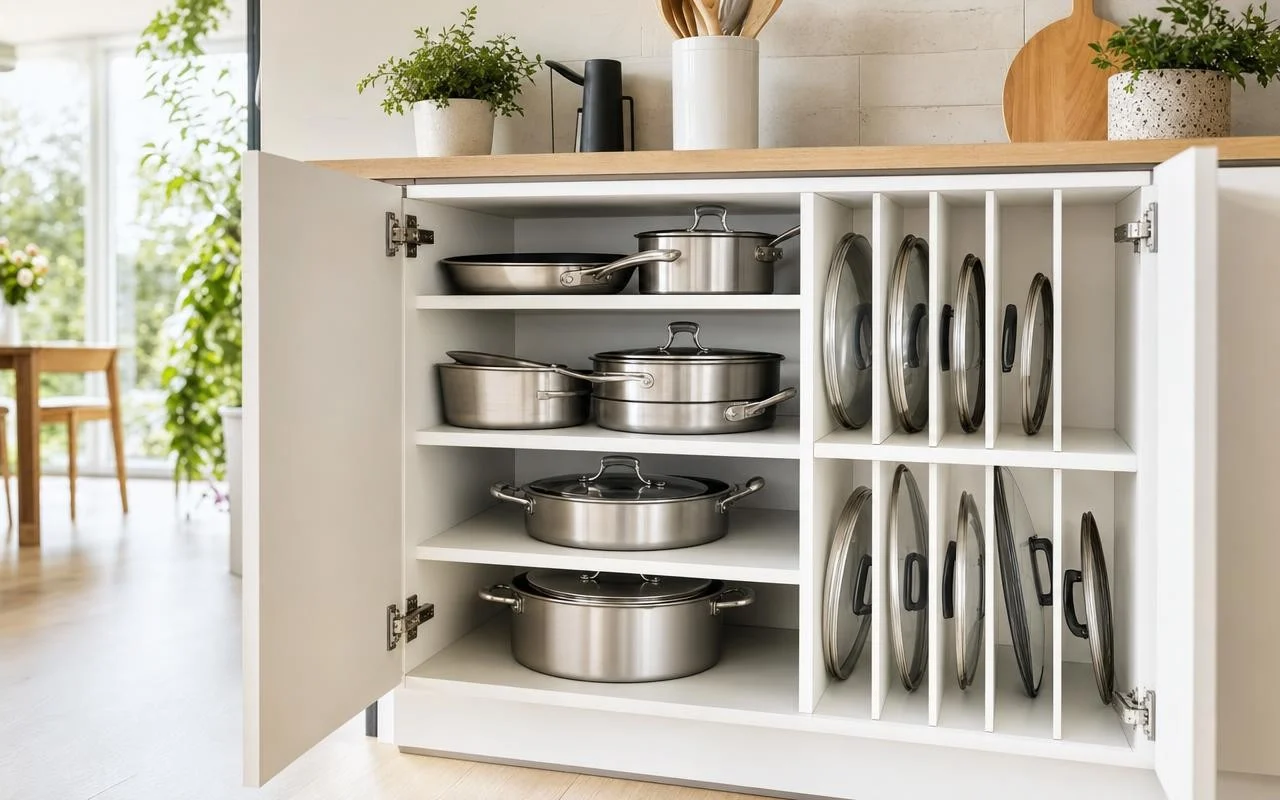
The pots-and-pans cabinet can sometimes resemble a failed circus act: wobbly spins of frying pans, lids jammed, the sound of metal every time the door opens. This was the case for a mother of a family, convinced that she was missing a piece of furniture or that she should part with half of her cookware. Until the day her daughter dumped everything onto the tile to “see clearly”.
In less than an hour, without buying a single accessory and without discarding a single pan, the pots-and-pans cabinet completely changed its look. The same skillets, the same lids, but an entire shelf freed, ready for serving dishes or cake pans. The secret wasn’t in a miracle product, but in two rules that professional cooks have followed forever.
Pourquoi votre placard à casseroles déborde avec une vaisselle raisonnable
In many kitchens, the pots and pans are stored as they are purchased, a bit haphazardly as they come. A pan here, a cast-iron pot there, each container placed with its lid screwed on top. Little by little, you end up with an unstable column that seems to fill the whole cabinet, even though the amount of dishware remains fairly modest. Space isn’t really the issue; it’s the organization that’s lacking.
The real space thief is the lids. Put on a pot, a lid prevents the next item from nesting inside, like Russian dolls. Each piece then occupies its full volume, instead of disappearing into the one below. In a standard 60 cm low cabinet where you often store 6 to 8 pieces, this detail is enough to give the impression of a saturated piece of furniture. As soon as the lids leave the stack, the lost volume reappears.
The method to store pots and pans like in a professional kitchen
The daughter of this reader began by removing all the lids to keep only the containers. Then she stacked the pots following a simple rule borrowed from the professional kitchen: the heaviest and widest at the bottom, the lightest and smallest at the top. The cast-iron pot ends up at the back, the small everyday pots at the top. Another detail that changes everything: the handles are oriented alternately to the right and to the left, to prevent them from getting stuck against one another.
Next, the question was where to store the lids. Three solutions work particularly well to maintain a cabinet organization that is easy to read:
- Standing on edge, in a lid organizer or in a simple dish-drying rack repurposed for lids.
- Mounted inside the cabinet door, thanks to a bar or hooks, to make use of this forgotten space.
- Stacked separately, from largest to smallest, in a dedicated corner of the cabinet.
Protect pans, lids and keep a pots-and-pans cabinet neatly organized for the long term
Storing in a column has a drawback: the stainless steel bottom of one pot can scratch the nonstick coating of the one placed beneath it. On stainless steel, marks are mostly cosmetic, but on a nonstick pan, they end up damaging the cooking surface, right in the center. Interleaving a separator between each piece completely changes the game. A store-bought felt, a circle of self-adhesive felt, or even a simple folded sheet of absorbent paper is enough to protect the ware, without spending a cent.
Cooks also avoid mixing materials: enamelled cast iron and stainless steel stay with each other, the nonstick goes on top, never beneath a harder piece. Pans store very well upright, on edge, in a vertical rack, handles oriented in the same direction to free up the bottom of the cabinet. In a corner cabinet, a turntable makes accessible a zone that is often blocked off. And one final rule to ensure the organization lasts: store only pots that are completely dry, to prevent marks, corrosion and musty odors, while keeping that famous shelf genuinely pleasant to use.
