
There is a word that has sneaked into our conversations about well-being, sleep, weight and even beauty: cortisol. On social media people are constantly talking about how to “lower cortisol,” and terms like the famous “cortisol face” have appeared.
But among so many viral tips, it’s easy to end up believing that there is a single food capable of solving all our problems at once.
The reality is quite simpler and also more interesting.
Cortisol is an essential hormone for our body. It helps us respond to stressful situations and participates in functions such as regulating glucose, blood pressure and the immune response.
The problem isn’t having cortisol, but remaining under stress for too long.
And here diet can indeed play a role. There is no magical food that makes cortisol disappear, but a balanced diet, rich in omega-3s, magnesium, fiber, vitamins and antioxidants, can be part of a strategy to take care of our health and our stress response.
The evidence on specific nutrients is still variable and does not allow turning these foods into a hormonal treatment.
If lately you feel you need to slow down, these are the ten foods I would keep closest at hand.
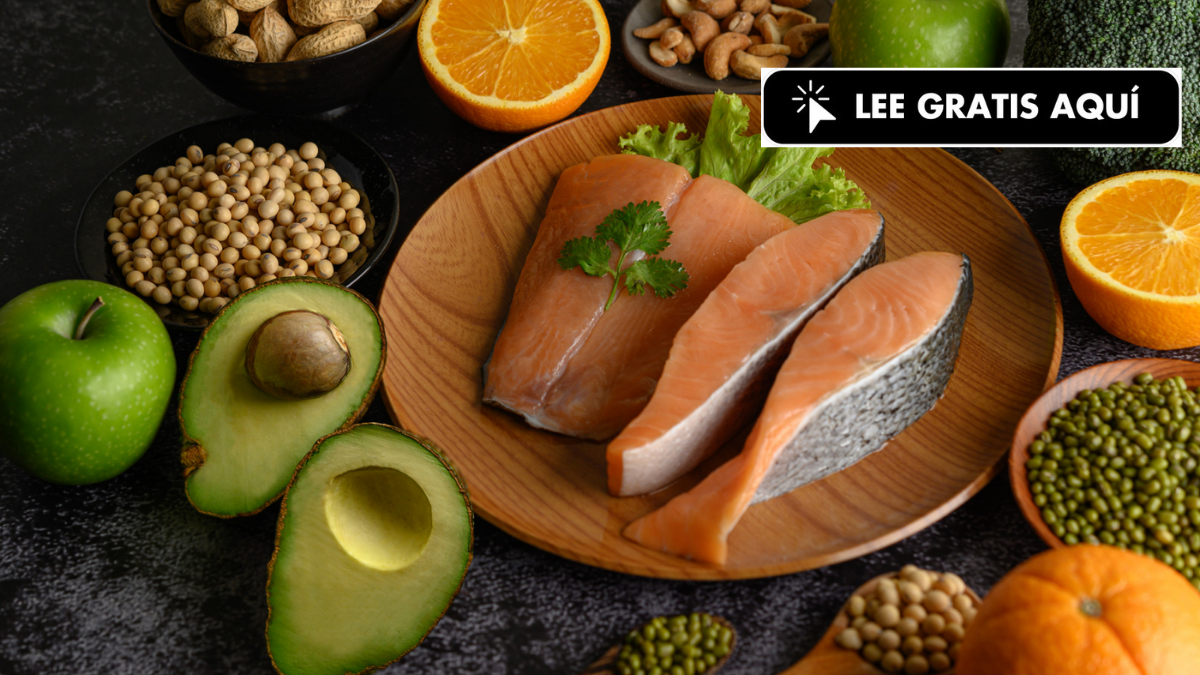
1. Salmon, avocado, and nuts: the trio I would start adding to my diet
Salmon. If I had to choose one food to start with, this would be it. Salmon and other fatty fish, such as sardines or mackerel, are rich in omega-3 fatty acids.
These nutrients have been studied for their possible relationship with the stress and anxiety response, although we should not interpret this as eating salmon automatically lowers cortisol.
Avocado. It provides healthy fats, fiber, potassium and magnesium.
It is, also, one of those foods that is extremely easy to incorporate: on a slice of toast, in a salad, or paired with eggs.
Nuts and other dried fruits. Almonds, hazelnuts, cashews or walnuts are a great option to have on hand when hunger strikes between meals. They provide unsaturated fats, fiber, magnesium and other micronutrients.
And here is a detail I find especially important: you don’t need to eat “perfectly” for our eating to be beneficial.
A handful of nuts, a portion of fish, or a few more vegetables a day can be much more realistic changes than attempting to transform our entire diet overnight.
2. These foods also deserve a place in your pantry
Spinach and other leafy greens. Spinach, arugula or kale provide folate, magnesium, fiber and antioxidants. They are an easy way to increase the nutritional density of any meal.
Legumes. Lentils, chickpeas, beans, peas or lupins provide fiber, plant-based proteins, vitamins and minerals. They also help build a more satisfying and balanced diet.
Red berries. Blueberries, raspberries, blackberries and currants are rich in antioxidant compounds. You can add them to yogurt, to porridge, or simply eat them as a snack.
Eggs. They are a high-quality protein source and contain choline, an important nutrient for the normal functioning of the brain. A breakfast with eggs can be a simple and satisfying option to start the day.
Chia seeds. They provide fiber and alpha-linolenic acid (ALA), a plant-based omega-3. They work especially well in yogurts, smoothies or puddings.
Dark chocolate. This is probably the item on the list I like the most because it shows that eating healthily doesn’t have to mean giving up small pleasures. Cacao contains flavonoids and other bioactive compounds. The key is the amount and choosing chocolate with a high cocoa content.
Green tea. It contains catechins and L-theanine, and some studies have investigated its relationship with the stress response. That said, it also contains caffeine, so if it affects your sleep, better not to drink it late in the day.
3. The real secret to controlling cortisol isn’t in a single food
Here comes the part that sells less on TikTok, but is probably the most important.
You don’t need to find the perfect food to “lower cortisol.” You need to reduce, as much as possible, what keeps your body permanently on alert.
Getting good sleep, exercising moderately, resting and finding tools to manage stress can have a much bigger impact than adding a specific ingredient to breakfast.
In fact, a review and meta-analysis of 58 studies found that various stress-management interventions, especially mindfulness, meditation and relaxation techniques, can yield favorable changes in cortisol levels.
I would also avoid entering into overly restrictive diets with the goal of “deflammation” or rapid weight loss. Fasting and intense caloric restriction can temporarily raise cortisol, according to a review and meta-analysis of energy-restriction studies.
That’s why, if I had to keep one idea after reading all this, it would be this: the aim isn’t to fight cortisol, but to give our body the conditions it needs to regulate it properly.
And that’s where the foods on this list come in: not as a miracle solution, but as part of a routine that helps us eat better, rest better and take care of our bodies when we’ve been living with stress at its peak for too long.
