
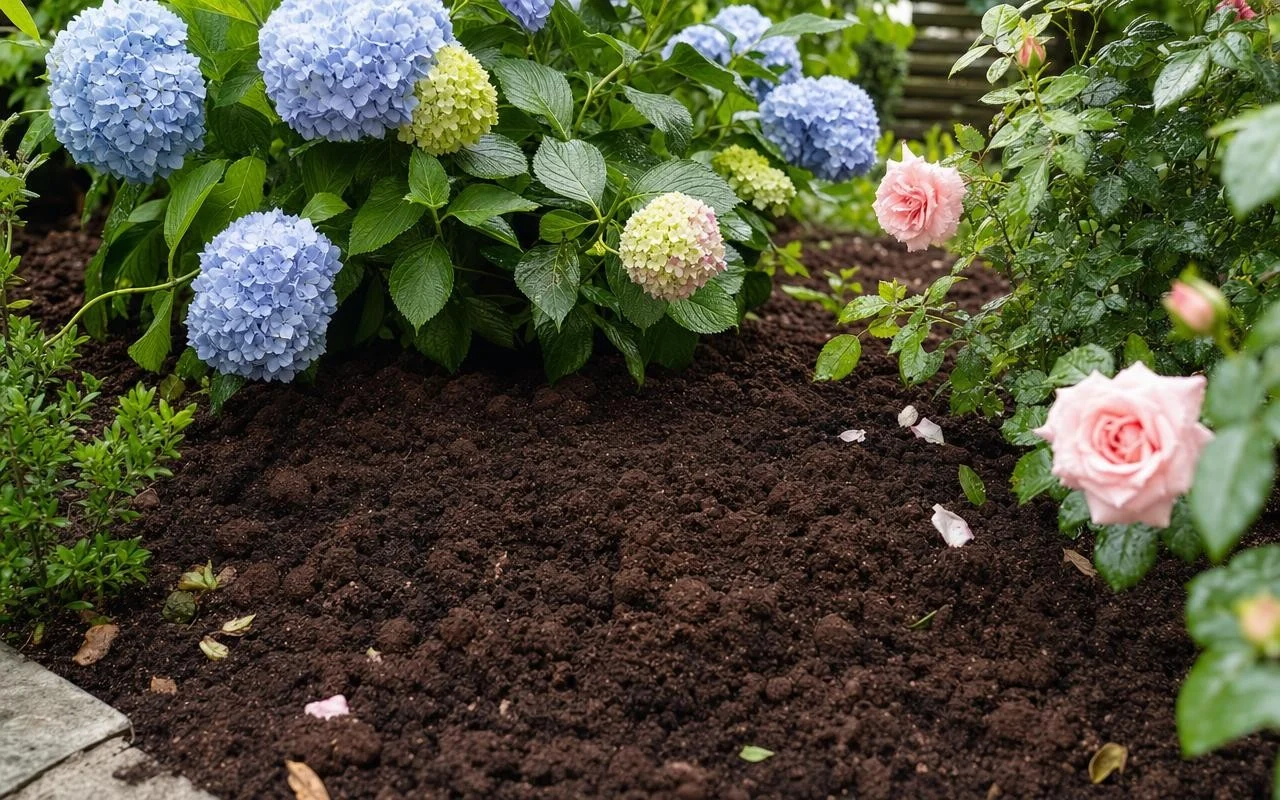
Across many outlets it is said that coffee grounds are the gardener’s black gold. Free, easy to collect, they promise greener plants and an abundance of blooms. Consequently, many people end up pouring used coffee grounds from the machine straight at the foot of their borders, around hydrangeas, or into pots, convinced they are giving their plants a perfect home-made fertilizer.
Coffee grounds indeed contain nitrogen and phosphorus and can stimulate growth, as Mon Jardin Ma Maison notes, while also helping to repel certain pests. However, when misused, the same grounds can literally suffocate the soil and hinder even the most vigorous plants.
Coffee Grounds: When a Good Homemade Fertilizer Becomes a Gardening Mistake
This scene is common: a dark layer of coffee grounds builds up around a rose bush or over an entire vegetable bed. At first, everything seems fine, then the watering water beads on the surface, leaves soften, some yellow. When you scratch, you discover a compact crust several millimeters thick that sticks to the fingers.
That’s where the most common mistake lies: using pure coffee grounds as a thick mulch. A specialized article relayed by AOL summarizes the trap very clearly by explaining that “the only thing never to do with coffee grounds in the garden is to pile it on as a thick surface layer, like a mulch.” In a layer that is too dense, it behaves like a lid that blocks water and air.
Coffee Grounds in a Thick Layer: What Really Happens in the Soil
The grounds consist of very fine particles. Once compacted by rain or watering, they clump and form an almost impermeable layer. According to the same source, “when piled in a thick layer, the coffee grounds compact into a dense sheet that prevents water from passing, so roots end up lacking water.” Plants may look fine at first, then their growth slows, or even stalls for the more sensitive species or those grown in pots.
Another often overlooked point: very fresh grounds, still loaded with caffeine and acids, can be phytotoxic. Studies cited by American universities have shown reduced germination and growth delays when used pure on seedlings. Soil microorganisms also use the coffee grounds’ nitrogen to break them down, which can cause a temporary nitrogen deficiency for plants and thus yellowing leaves. Regarding pH, spent grounds are close to neutral; they do not strongly acidify the soil, though they remain favored by so-called acid-loving plants like Japanese maple or rhododendron when used sparingly and on the surface.
Using Coffee Grounds as Fertilizer Without Smothering Your Plants
Good news, you can still benefit from coffee grounds without making this error. The House Digest article recommends treating them as a soil seasoning: “coffee grounds are somewhat like a seasoning for your soil: you should sprinkle them or lightly scratch them in, and not dump them in piles around the plants.” Practically, experts recommend never exceeding a thin veil of about 1 cm on the surface, and only if you then cover with a coarser mulch (shredded material, chips) over 5 to 10 cm to keep the soil aerated.
The safest use remains compost. Several science communication services advise limiting the grounds to about 20% of the total compost volume, mixed with carbon-rich materials such as fallen leaves or straw. In this framework, it provides nitrogen, nourishes soil microorganisms and could even help limit certain fungal diseases. For a Japanese maple or a hydrangea, sites like Deavita simply suggest mixing “a little” dry grounds into the top layer of soil in spring. If there is already too thick a layer in the garden, just break it with a rake, remove the excess to put it in the compost, aerate the soil, then install a coarse mulch so that roots can easily access water and oxygen.
Sources
- Mon Jardin Ma Maison
“This gardener shares the recipe for his natural fertilizer based on cinnamon and coffee grounds”
