
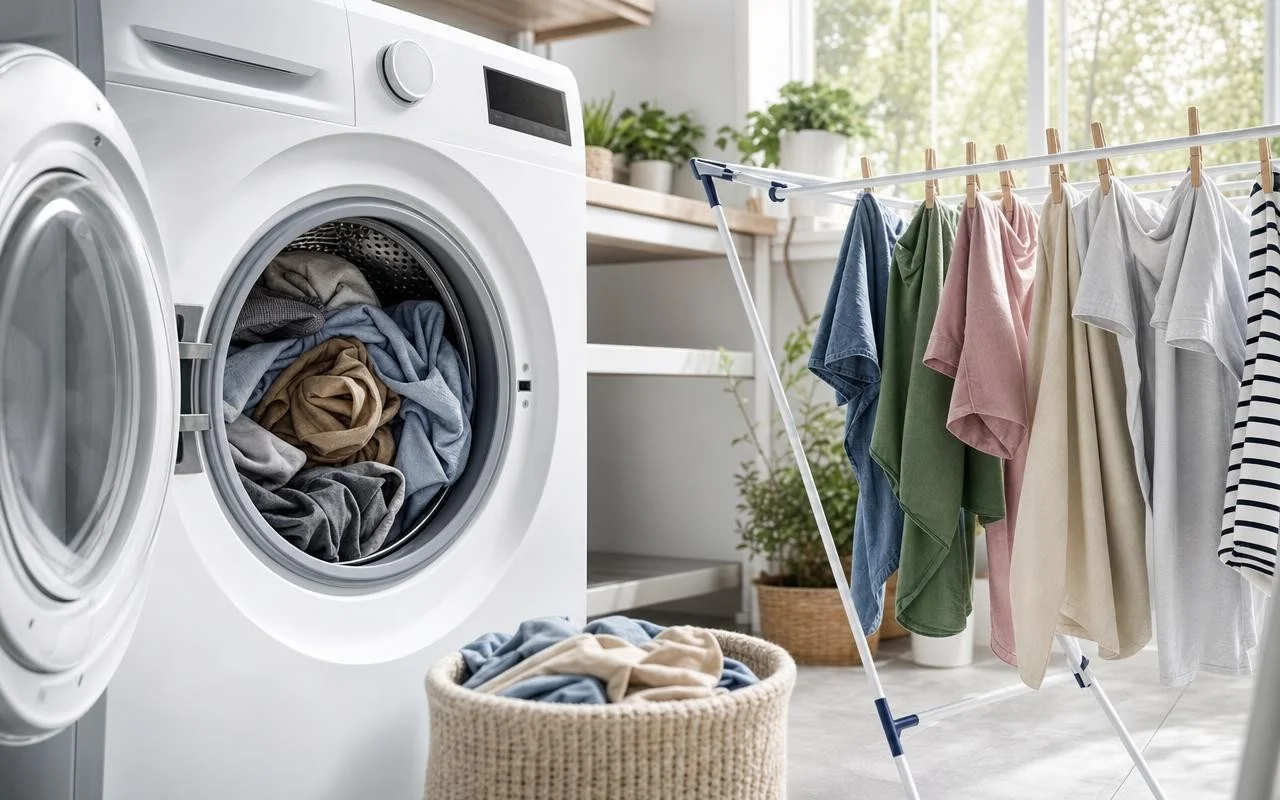
For years I mechanically pressed the maximum spin option, convinced I was saving precious hours of drying time. The laundry came out almost light, and I congratulated myself in front of the drum, sure I had found the key to chaining washing, airing, and folding without losing a minute. Yet when it came time to take the clothes down, I always encountered the same wrinkled shirts and the same jeans still chilly at the hems.
This scenario wasn’t born from poor washing nor a poorly placed drying rack, but from a very common reflex: always starting with a full-throttle spin. By compacting the fibers, this extreme speed traps moisture and leaves stubborn creases, something that manufacturer manuals confirm. The effect is particularly evident in summer, when one hopes for express drying on the balcony or in the garden. The real time gain hides somewhere else.
Why max spin slows drying and creases the laundry
When the machine runs at a very high spin speed, the garments press against the drum walls into a dense block. The fabric layers cling together, fibers get crushed, and air barely circulates. Water is expelled at the surface, giving the impression of almost-dry textiles to the touch, but part of the moisture remains trapped at the core of sleeves, pockets, or hems.
On a clothesline, this compacting translates into very uneven air-drying: a T-shirt may feel dry, but the collar edges stay damp, towels retain a cool spot in the middle. Online help desks from brands like Siemens or Electrolux describe the same phenomenon when the spin is too high and the drum too full. The folds end up literally imprinted into the fabric, which lengthens ironing and wears the fibers over time.
Ideal spin speed: 800 to 1000 rpm depending on your laundry
To limit these effects without dragging a dripping cloth out of the washing machine, many specialists recommend aiming for a middle ground, around 800 to 1000 rpm, for the majority of everyday garments. At this pace, you remove a substantial amount of water while leaving pieces more airy and mobile inside the drum. The laundry separates more easily from one another, and moisture escapes more readily once hung.
Recommendations from manufacturers then vary by fabric: wool generally tolerates 600 to 800 rpm, synthetic textiles 800 to 1000, cotton can go up to 1400 rpm. If your priority remains minimal wrinkling and naturally fast drying, staying in the mid-range often suffices. For those who later use a clothes dryer, a higher spin, around 1200 rpm, reduces run time, provided you don’t overload the machine.
Routine express pour un linge qui sèche vite sans se froisser
Spin settings aren’t everything. A drum that is too full prevents clothes from dropping freely, which amplifies creases and damp spots. Brand guides often advise not exceeding two-thirds of capacity. Another key point: measure the detergent, remove the laundry as soon as the cycle ends, give it a shake, smooth sleeves and collars, then lay it out with space between each item.
Once on the clothesline, how you arrange the laundry matters: space out the pegs, open pockets, fold sheets in half lengthwise to minimize markings while still allowing air to pass. Shirts or dresses hung on hangers take on a neater shape as they dry. Since I abandoned the option of full-throttle spin, I spend less time ironing and my laundry routine fits much more smoothly into daily life.
