
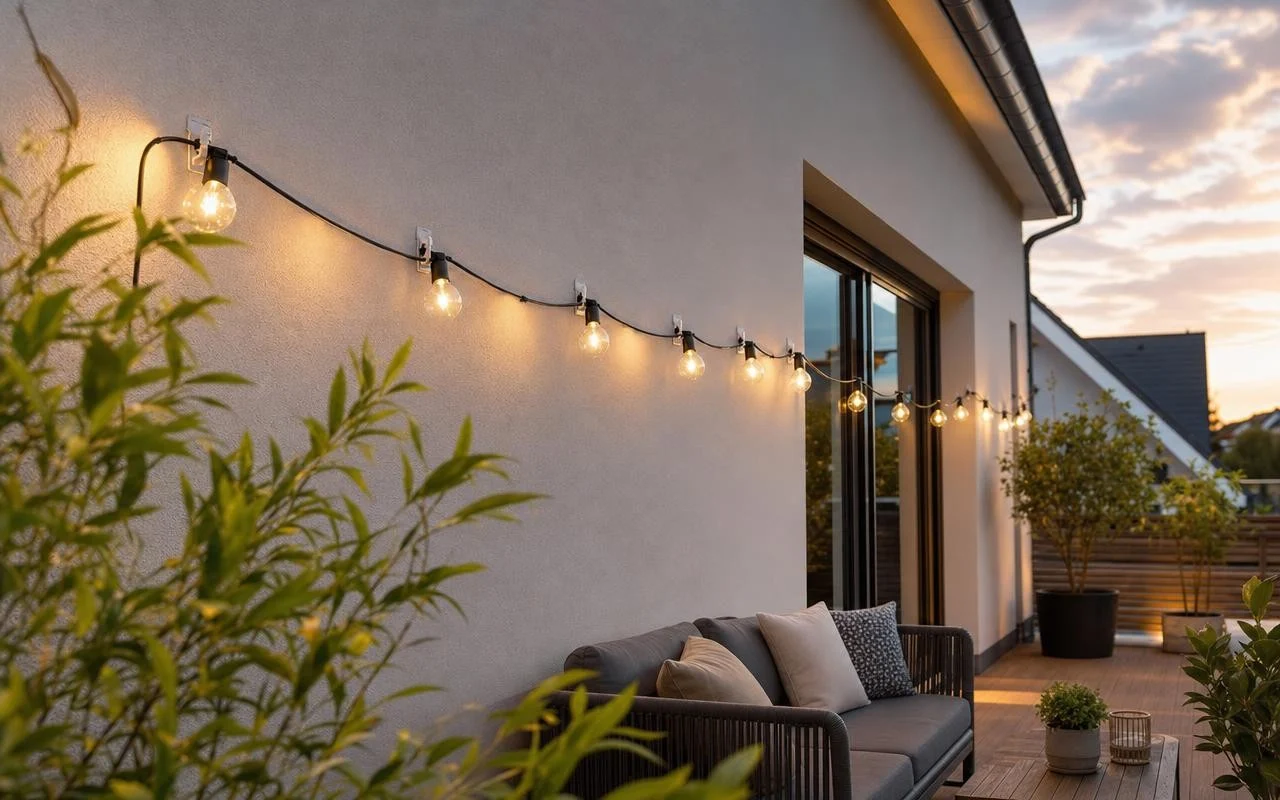
A pretty outdoor string light in the garden or on the balcony is everyone’s dream. The problem appears when it’s time to fix it: nails that damage the plaster, holes that are impossible to patch cleanly, or adhesives that fail at the first gust. Many end up giving up, especially in regions where summer storms seriously shake façades.
There is, however, a discreet method to secure an outdoor string light without drilling, using only glued hooks, while withstanding the wind. It rests on three simple actions: properly preparing the surface, choosing the right outdoor hardware, then mounting the cable with a small, surprisingly effective mechanical trick. The key happens well before you light up the garland.
Why the garland comes loose at the first gust of wind
In most cases, it isn’t the glue that’s at fault, but the way the cable is tensioned. When the garland is pulled taut between two anchor points, each gust creates very abrupt jerks on the hook. This direct traction eventually pulls off the adhesive, especially on a slightly dusty or damp stucco, typical of exposed façades.
Another often overlooked point: wall preparation. Dust, grease, and traces of pollution form a film that prevents exterior adhesive hooks from sticking well. Guides advise degreasing the area with a bit of rubbing alcohol or white alcohol vinegar on a clean cloth, then letting it dry completely. It’s only on this clean surface that exterior double-sided tape can truly adhere and resist the weather.
The right hardware to fix an outdoor garland without drilling and withstand the wind
For a durable installation, you need hooks or clips designed for outdoor use, with reinforced adhesive. Some manufacturers claim loads of about 150 to 500 g per hook, sometimes up to 2 kg for sturdy models, provided you respect the type of surface. Outdoor-specific clips recommend an anchor point roughly every 60 cm and indicate a service temperature range from about -29 °C to +51 °C.
The manuals often suggest pressing firmly on each hook for a minute, then waiting at least an hour before hanging the garland, giving the adhesive time to set properly. To keep the cable in shape and prevent slipping, the use of black UV-resistant nylon cable ties is strongly advised. Basic models tend to degrade in the sun, whereas UV-treated ones hold up well through the summer. The last point to check: an outdoor garland with an IP rating of at least IP44, suitable for rain and splashes.
Slack loop and UV cable ties: the anti-gust trick for the garland
For an adhesive fixation to resist gusts, the detail that changes everything is the slack loop. Rather than pulling the cable taut to the hook, deliberately leave a bit of slack just before each anchor point, forming a small arc. When the wind shakes the garland, this loop acts as a shock absorber: the wire moves, absorbs the jolts, but the traction transmitted to the adhesive remains low.
Concretely, the method can be boiled down to three steps: clean and degrease the façade, apply the exterior adhesive hooks while respecting the curing time, then hang the garland keeping slack before each hook, secured with UV cable ties tightened but without crushing the cable. You obtain a fixation that withstands rain, sun and gusts, while preserving the façade from any holes or hammer marks, and which can be removed cleanly if one day you decide to change décor.
