
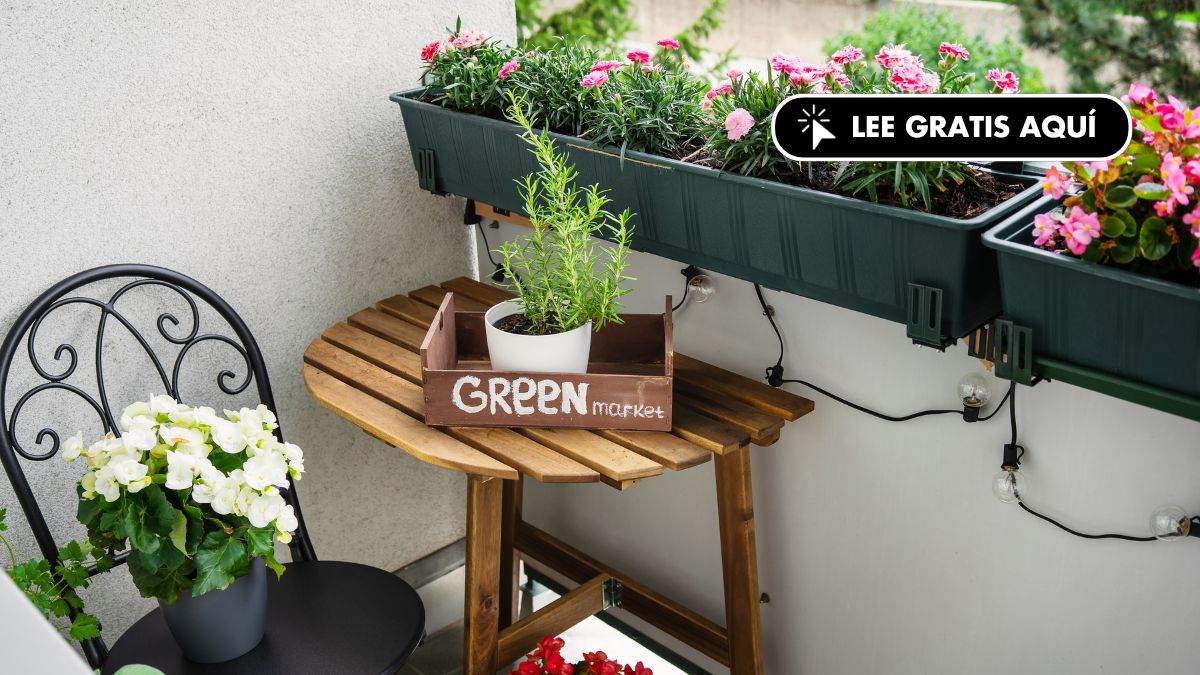
Is the air inside your home truly safe? What science says about plants that help combat indoor pollution
Dr. Laura Zapata warns about the pollution that can accumulate in enclosed spaces and points to five plants studied for their ability to capture certain contaminants. Science confirms the existence of a phytoremediation mechanism, but with an important caveat: laboratory results do not mean that a few plants can substitute ventilation or air filtration in a dwelling.
We breathe thousands of times a day, but we rarely consider the quality of the air entering our lungs when we are at home or in the office.
And we spend a great deal of time indoors.
A landmark study, the National Human Activity Pattern Survey (NHAPS), published in the Journal of Exposure Science & Environmental Epidemiology, found that participants spent, on average, about 87% of their time inside buildings, in addition to another 6% in enclosed vehicles.
For Dr. Laura Zapata, this reality deserves greater attention from a health perspective: “As a physician, I focus on systemic health, and we often forget that the environment where we spend 90% of our time directly affects our inflammation and lung health.”
Although that “90%” should be understood as an approximation —studies show differences by population and lifestyle— the underlying message has scientific support: exposure to indoor pollutants can be relevant precisely because we spend many hours in those environments.
The So-Called Sick Building Syndrome
Dr. Zapata also focuses on a concept recognized for decades: “Sick Building Syndrome is not a myth; it is the buildup of volatile organic compounds (VOCs) such as formaldehyde, benzene, and xylene in closed spaces.”
Here a clarification is necessary.
The United States Environmental Protection Agency (EPA) defines Sick Building Syndrome (SBS) as a situation in which occupants experience acute symptoms temporally related to their presence in a building, but in which the disease or a specific cause cannot necessarily be identified.
Among the symptoms described are fatigue, headaches, dizziness, irritation of mucous membranes, nasal congestion, and difficulties with concentration. Therefore, VOCs can be one of the contributing factors, but they are not the sole cause of the syndrome. Inadequate ventilation, biological contaminants, moisture, mold, and other environmental factors can also play a role.
Can plants clean the air?
This idea became globally known thanks to the so-called NASA Clean Air Study.
In 1989, researchers affiliated with NASA studied various ornamental plants and their capacity to remove chemical substances from the air, including benzene, trichloroethylene, and formaldehyde. The experiments found that certain plant–substrate systems could reduce these compounds under the controlled conditions used.
Dr. Zapata sums it up this way: “Based on the NASA Clean Air Study and on principles of environmental medicine, today I present five biological allies to ‘clean’ your surroundings.”
These are the five plants she highlights.
1. Peace Lily (Spathiphyllum)
“Peace Lily: It is the most potent filter. It is among the few species capable of neutralizing ammonia and reducing mold spores, which is vital for patients with rhinitis or asthma.”
The Spathiphyllum is one of the most studied plants in phytoremediation experiments. Recent research continues to find the ability to remove certain VOCs in closed experimental chambers. For example, a 2024 study analyzed Spathiphyllum wallisii, Epipremnum aureum, and Chlorophytum comosum against formaldehyde and observed remediation capabilities under the controlled conditions of the experiment.
It has also been studied in active botanical biofilters to remove VOCs and particulate matter from tobacco smoke, with promising results. An active biofilter, however, is not the same as simply placing a pot in a room.
There is no evidence that having a peace lily at home serves as a treatment for rhinitis or asthma. In fact, in homes with dampness or mold, health recommendations focus on eliminating the moisture source and preventing microbial growth.
Careful with pets: the ASPCA lists the peace lily as toxic to dogs and cats due to its insoluble calcium oxalate crystals.
2. Snake Plant / Mother-in-Law’s Tongue (Dracaena/Sansevieria trifasciata)
“Mother-in-Law’s Tongue: Unlike most plants, it operates at night. Through CAM metabolism, it releases oxygen while you sleep, optimizing the partial pressure of O2 in your bedroom.”
Mother-in-Law’s Tongue uses crassulacean acid metabolism (CAM), an adaptation in which the plant mainly opens its stomata at night to take in CO₂ and reduce water loss.
However, from this mechanism one cannot conclude that a single pot will clinically improve the partial pressure of oxygen in a bedroom. The gas-exchange rate of a houseplant is too small to justify that claim in real-world conditions.
The plant can be botanically interesting and has appeared in air-quality studies, but it should not be presented as a form of nocturnal “oxygen therapy.”
3. Rubber Plant (Ficus elastica)
“Rubber Plant: A ‘shield’ against formaldehyde (present in carpet and furniture adhesives). In addition, its high transpiration acts as a natural humidifier for your respiratory mucosa.”
Formaldehyde is one of the indoor pollutants that has received substantial attention and can originate from certain building materials, furniture, pressed-wood products, and other household items.
Classical phytoremediation studies showed that different systems formed by plants, roots, and substrate can intervene in the elimination of gaseous contaminants.
Plants also transpire water, and thus can contribute to ambient humidity to some extent. But this effect depends greatly on the number and size of the plants, the temperature, watering, ventilation, and room dimensions. It should not be equated with the controlled operation of a humidifier.
And more humidity does not always translate into better respiratory health: persistent moisture increases the risk of mold growth, which is associated with respiratory symptoms, allergies, and asthma.
4. Spider Plant (Chlorophytum comosum)
“Spider Plant: Its efficacy is remarkable; it removes carbon monoxide with clinical speed. It is the safest option if you share your home with pets.”
The spider plant frequently appears in phytoremediation research, and recent experimental studies have also noted its capacity to reduce formaldehyde in controlled chambers.
However, the phrase “clinical speed” is not supported for the removal of carbon monoxide in a real home. This is especially important because carbon monoxide (CO) is a potentially deadly gas: no plant should be considered a protective measure against CO leaks.
Where the spider plant does stand out is in its compatibility with household animals. The ASPCA considers Chlorophytum comosum non-toxic to dogs and cats.
5. Pothos (Epipremnum aureum)
“Pothos: The all-rounder. It absorbs xylene and helps mitigate mental fatigue and oxidative stress induced by indoor pollution in offices.”
Pothos also features in the literature on experimental removal of contaminants. In the 2024 study on formaldehyde, Epipremnum aureum demonstrated remediation capacity within a closed chamber.
The presence of indoor vegetation is also studied for its potential effects on wellbeing, perception of the environment, and stress, but these benefits must be distinguished from the chemical elimination of contaminants. There is not enough evidence to claim that a pothos, by absorbing xylene, clinically reduces the “oxidative stress” produced by office pollution.
Additionally, those living with animals should know that pothos is classified by the ASPCA as toxic to dogs and cats.
How does phytoremediation really work?
Dr. Zapata explains: “These phytoremediation processes occur through the stomata of the leaves and microorganisms in the roots, which break down the toxins and convert them into nutrients for the plant.”
This statement captures one of the most interesting aspects of the research.
The system does not rely solely on the leaves. The NASA studies already paid attention to the entire plant–substrate–microorganism ensemble, and subsequent research has continued to explore the role of the substrate and the microbial community in eliminating VOCs.
In fact, this interaction has fueled a more sophisticated line of inquiry: active botanical biofilters, which force contaminated air to pass through the plant system and its substrate to increase contact and, with it, the removal capacity.
The Big Nuance the Science Introduced After NASA’s Study
Here lies probably the most important data for properly interpreting all of the above.
The famous NASA experiment was carried out under controlled conditions that do not fully replicate a typical home. A house has doors, windows, air leaks, ventilation, and a volume that is much larger.
In 2020, Bryan Cummings and Michael Waring published a relevant review in Journal of Exposure Science & Environmental Epidemiology. The researchers analyzed 12 studies and 196 experimental results on the removal of VOCs by potted plants.
Their conclusion substantially changes the popular interpretation of NASA’s Clean Air Study.
According to their calculations, you would need roughly between 10 and 1,000 plants per square meter of surface to achieve a VOC removal capacity comparable to the typical exterior–interior air exchange of a standard building.
In other words: plants can indeed capture certain contaminants under experimental conditions, but a few pots do not function as an air purifier capable of substituting a home’s ventilation.
That gap between “a plant can remove a contaminant in a laboratory chamber” and “a plant effectively cleans the air in my bedroom” is fundamental.
So, is it worth having plants at home?
Yes, but not as a medical treatment or as a substitute for effective air-quality measures.
Research into phytoremediation is real and continues to progress, especially through active biofiltration systems. But to protect a dwelling’s air quality, essential measures remain: control pollution sources, maintain adequate ventilation, and address humidity and mold problems.
Particularly important: a plant never replaces a carbon monoxide detector, proper ventilation, or the removal of a contaminant source.
The scientific evidence thus invites interpreting Dr. Zapata’s words with a nuance. Plants are remarkable organisms capable of interacting with environmental contaminants, and some species have demonstrated notable phytoremediation abilities in the lab. But translating those results directly to a home requires caution.
Dr. Zapata concludes: “Health begins with what you breathe. Do you have any of these at home?”
Perhaps the question is not only which plants sit in our living room, but what we are actually breathing, where those contaminants come from, and which genuinely effective measures we are taking to reduce our exposure.
View this post on Instagram
James Whitaker
I’m James Whitaker, a UK-based journalist focused on emerging trends and everyday stories gaining attention across the country. I cover the topics people start talking about before they fully break into the mainstream. My work aims to stay clear, factual, and closely connected to how news is actually consumed today.