
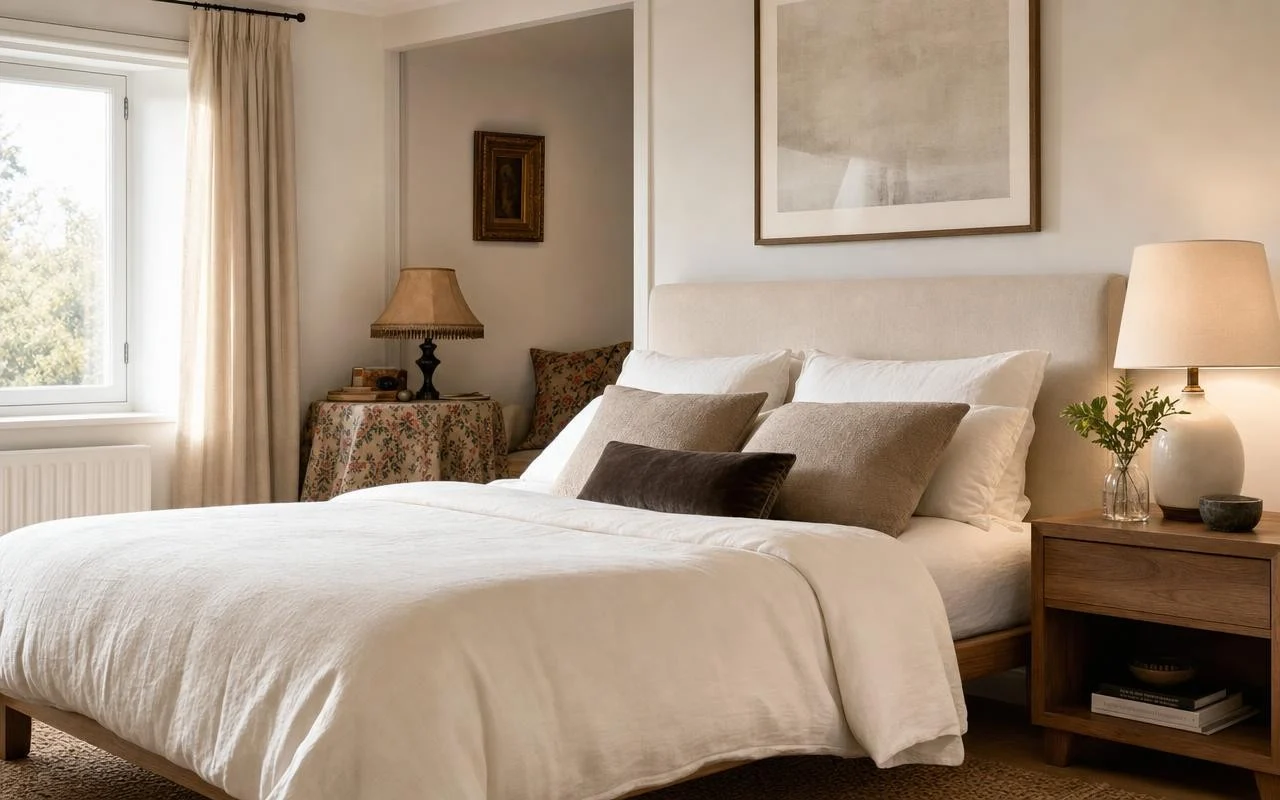
Many bedrooms look clean, trendy, perfectly coordinated… and yet already give the impression of being outdated. Interior decorators see it every day: a few details are enough to date a room, even when the paint is fresh and the bed is new. Good news, it’s often enough to remove them to rediscover a truly timeless bedroom.
For these professionals, the idea isn’t to ban personality, but to move away from micro-trends that wear out in two or three years. A bedroom designed to last costs less in the long run and stays more restful on a daily basis. Five families of objects recur constantly in their assessments: these are the ones they recommend getting rid of first.
For a timeless bedroom, out with wall slogans and knick-knacks everywhere
The first instinct of decorators: look at the walls. Large panels with clichés or slogans, hung above the bed, have become for them the symbol of décor that is quickly seen and quickly dated. Kanika Bakshi Khurana, an interior designer, advises keeping only the pieces that are truly meaningful: “If there is a sentimental panel that must stay in your bedroom, it’s better to move it to a more discreet corner rather than making it the focal point.” A photo you love, a textile, or an antique mirror will offer a more personal presence.
The surfaces tell just as much. A crowd of small objects lined up on the nightstand, the dresser, and the shelves ends up creating an impression of permanent clutter, even when everything is tidy. Swati Goorha, interior architect, reminds us that “environments that truly endure give time for objects and materials to breathe.” It’s better to choose a few pieces dear to you, group them into small scenes, and store the rest to bring them out from time to time.
Trendy textures and bedding: what quickly ages a bedroom
Another trap that distances a space from lasting charm: putting all your eggs in one very fashionable texture. Bouclé armchair, rattan headboard, fluted nightstands… taken separately, these elements can be stunning, but multiplied in the same room, they trap it in a specific era. Kanika Bakshi Khurana recommends keeping the furniture you love, but “adding a contrasting texture such as wood, linen, cotton or wool.” A combination of materials gives depth and interest to a room, whereas a single repeated aspect robs it of richness.
Bed textiles follow the same logic. A highly graphic duvet cover paired with an avalanche of decorative cushions will quickly look dated and visually tiring. Swati Goorha suggests “creating a unified base on the bed, with high-quality materials and a more organic feel, in neutral colors in the background.” On this calm base, you can add a patterned throw or one or two bold cushions, easy to replace when the urge to change arises.
Layout, symmetry and light: say goodbye to the showroom look
Many bedrooms follow the same scheme: bed centered, two identical nightstands, twin lamps. For Kanika Bakshi Khurana, this overly uniform staging makes the room resemble a showroom more than a living space. A timeless bedroom accepts a bit of asymmetry: a side table on one side, a small desk on the other, or two nightstands of different but similar heights. Comfort in use matters more than an impeccably matched appearance.
Decorators also look at the lighting, which is often too uniform as well. A single ceiling bulb provides flat brightness, harsh shadows, and a cold ambiance. They favor multiple sources placed around 1.50 meters high (table lamps, wall sconces, reading lamps), with warm bulbs between 2700 and 3000 kelvin and, if possible, a dimmer to modulate intensity.
